Religious ceremony
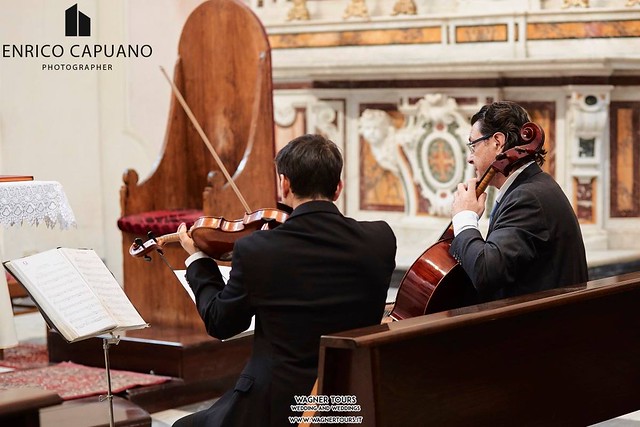
Everything must be perfect on the wedding day, but the most intense moment is definitely the church ceremony.
Music represents an essential element: it arouses emotions and creates a romantic and suggestive atmosphere. There is a pipe organ in every Church and the easiest thing is to paire it with a violin and a voice (soprano or tenor). Another choice can be to replace the classical sound of the pipe organ with that of a string trio or quartet. Both are “independent” formations to which, if desired, a solo
instrument (like a flute or an oboe) or the voice of a soprano or tenor singer. For even more unique ceremonies, it is possible to combine the strings with the magical sound of a harp.
As regards the repertoire, the religious ceremony demands sobriety and elegance. It is important to agree on the pieces with the priest, favouring classical, traditional or, better yet, religious pieces.It is a fine thing to welcome the guests, while waiting for the bride’s arrival, with a soft and quiet repertoire. The moments requiring the presence of music are: the bride’s arrival, the exchange of rings, the offertory, the holy communion, the appending of signatures, the exit of the spouses. The presence of a voice allows to accompany the Alleluja and the Santus with the singing.
As for the repertoire, always in accordance with the priest, we have a wide range of choice. Here are some examples:Bride’s entrance:
– R. Wagner: Marcia nuziale del Lohengrin – F. Mendelssohn: Marcia nuziale
– M. A. Charpentier: Preludio al Te Deum – Pachelbel – CanoneCommunion:
– C.Gounod : Ave Maria
– F. Schubert: Ave Maria
– G.F. Händel: Largo da Serse – C.Franck: Panis AngelicusExit:
– F. Mendelssohn: Marcia nuziale
– F. Mendelssohn: Marcia dei Sacerdoti
– L.v.Beethoven: Inno alla gioia
– A.Vivaldi: La primavera
Every ceremony is different: it will be our care to adapt the repertoire to the personality of the married couple.